
Signal active
skill gap
ubi floor
operator test
Urgent/☠ AI risk diagnosticAI operating-risk diagnostic/7–10 min7–10 minutes • instant verdict
Find out if your business will survive the AI apocalypse
The real question is whether you have enough AI skill to build with it — or whether you are just using it while the market pushes your current skills toward the UBI floor.
7–10 minutes • instant score • built for founders, builders, consultants, coaches, marketers, and business owners

The AI apocalypse, defined
The skill gap gets wider faster than people think.
Every month you wait, AI-first operators turn prompts into workflows, workflows into systems, systems into data loops, and data loops into faster decisions. Late adopters must learn AI and rebuild operations at the same time.
What we mean
The old work math breaks.
Not robots. Not sci-fi. The market starts asking why it should pay slow humans for work that AI-assisted operators can do faster, cheaper, and more often.
Why it is different
This is not websites, cars, or electricity.
Those tools mostly helped people do the same work. AI can think through parts of the work, use tools, create drafts, check itself, and run the next step. The fight is speed.
What must happen
Become an AI Operator now.
Pick three repeated tasks, define what goes in, what comes out, who checks it, what can go wrong, and how you know it worked. That is how you stop dabbling and start surviving.
Visual diagnosis
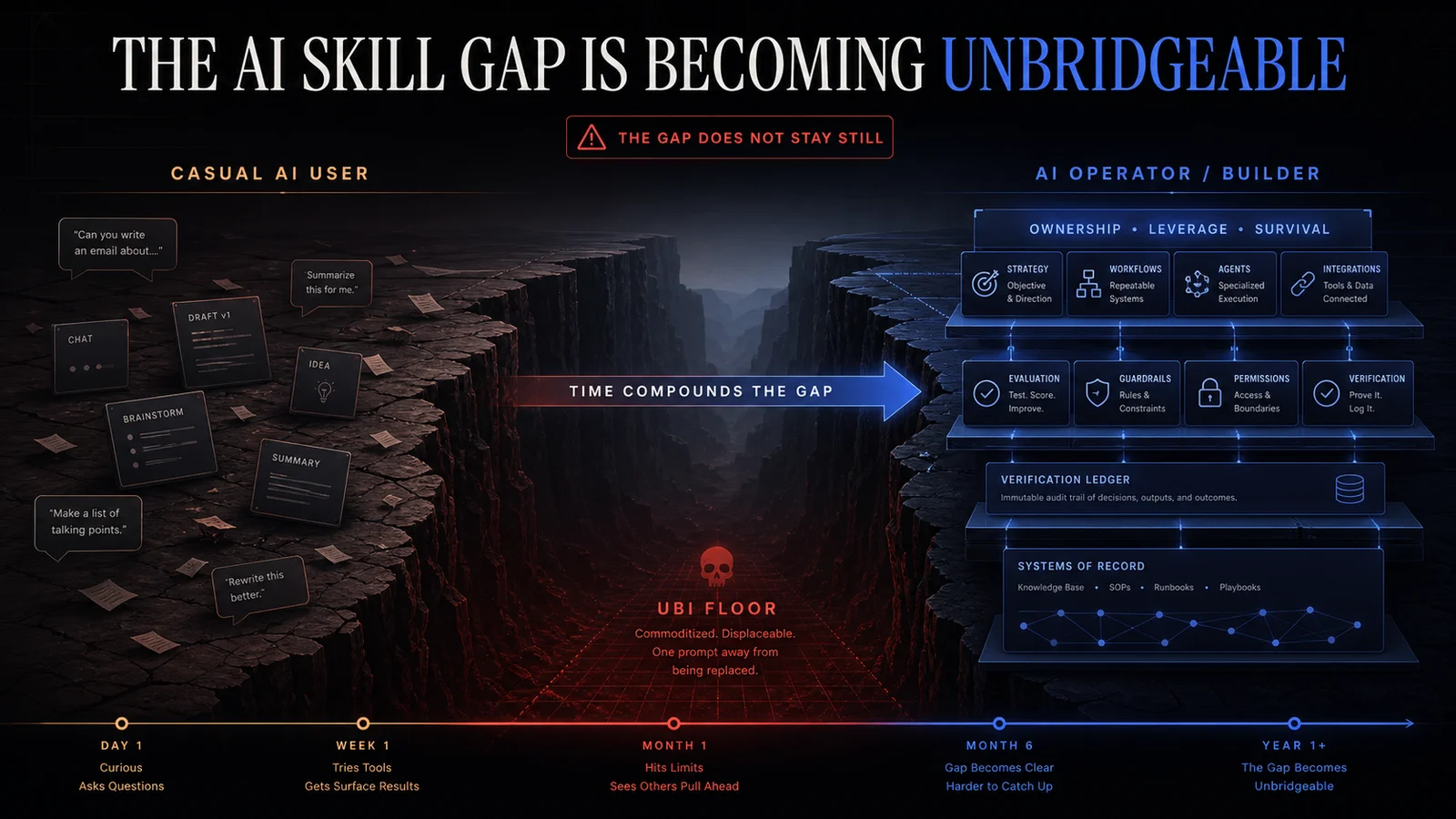
The AI skill gap is not a line. It is a canyon.
Casual users get faster at isolated tasks. Builders turn AI into repeatable execution. The longer that gap compounds, the more expensive it gets to cross.
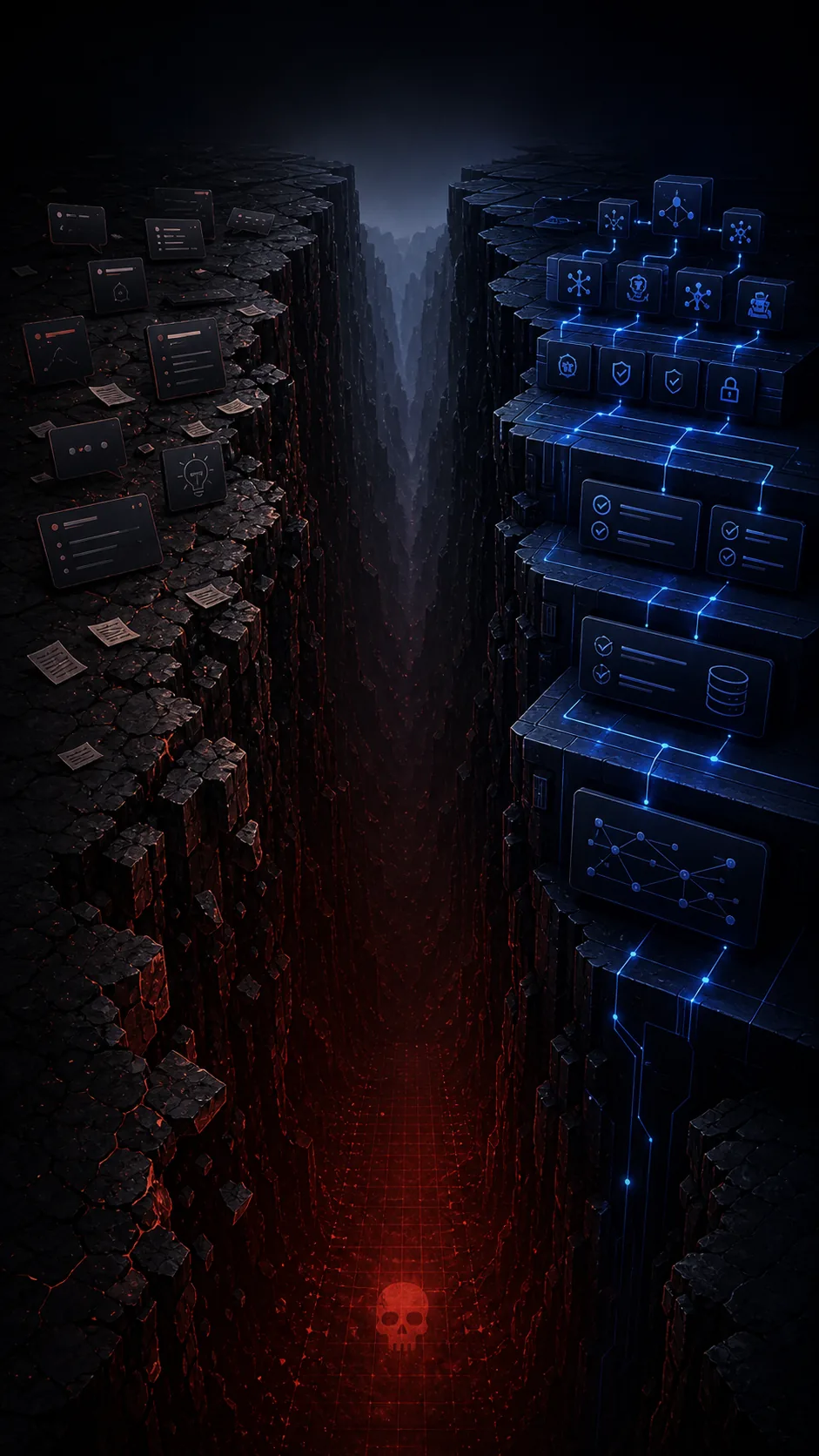
Mobile doom map
The gap widens downward.
On mobile, this is the same picture turned into a scroll: casual AI use drops toward the floor while builders stack systems.
Casual AI user
AI operator
☠ UBI floor
The bottom of the canyon is commoditized labor.
Time compounds downward
Day 1
CuriousAsks AI for drafts.
Looks productive. Still manual. Still dependent on taste, memory, and vibes.
Week 1
Surface speedCollects tools.
More apps, more prompts, more noise — but no reusable operating system.
Month 1
Limits hitThe floor starts moving.
Basic AI output gets cheap. The market stops rewarding people for merely producing first drafts.
Time compounds the gap ↓
☠
UBI floor
Commoditized. Displaceable. One prompt away.
This is the economic danger zone: AI can do the obvious parts, and you have not learned to direct the system.
AI operator / builder
Ownership, leverage, survival.
Strategy
Workflows
Agents
Integrations
Evals
Guardrails
Permissions
Verification
System of record
Knowledge base, SOPs, runbooks, playbooks, proof.
Dabbling side
Prompts, drafts, summaries.
Useful, but fragile. The work still depends on a human manually steering every output.
Builder side
Workflows, agents, evals.
This is where speed compounds: reusable systems, checks, permissions, and proof.
The warning
The floor keeps dropping.
If AI makes your current labor cheap, survival depends on becoming the operator — not the task.

Why UBI is the fallback, not the plan
When AI labor gets cheaper than human labor, weak operators get cheaper too.
UBI means universal basic income. It is in this diagnostic because it is the endpoint of economic displacement: AI makes work cheaper, AI-first businesses need fewer people, manual workers become easier to replace, and subsidized survival becomes the fallback after your current skill set stops being rare.
Now
+12 mo
+24 mo
+36 mo
Pressure curve: automation capability ↑ / routine labor demand ↓ / UBI debate ↑
Business consequence
If your work is still manual, slow, undocumented, and owner-dependent, AI does not have to “replace” you. It only has to make your competitors impossible to match.
The no-escape architecture
The Predictor makes you choose what you would actually do.
Every scored question is a business scenario. Four keystone decisions also ask how confident you are. Wrong plus confident becomes the Blindspot Index — the part of the result most people cannot argue with.
Delegation
Can you turn outcomes into clear AI work packets — context, constraints, examples, standards, and escalation rules?
Verification
Can you catch bad facts, weak reasoning, silent failure, and risky assumptions before they hit customers?
Systemization
Can you turn repeated work into a machine that runs again next week without you rebuilding it from scratch?
Result system
Not “good” or “bad.” Exposed, fragile, or agent-ready.
The result page shows your score, weakest pillars, practical workflow grade, Blindspot Index, and the specific decisions that exposed the gap. The point is to force clarity: either your business can operate with AI, or the market eventually treats the old way of working as overhead.
The line
AI will not politely warn you before the market gets cruel. A faster AI builder just starts eating the customers you thought were safe.
Critical
0–29
AI-enabled competitors can out-produce, out-test, and out-respond before you catch up.
Exposed
30–69
You may be getting speed from AI, but the way you work is still fragile enough to burn under pressure.
Agent-Ready
70–100
You are close to making AI a real business machine instead of a lucky speed boost.
Next step
Close the AI gaps before they close your future.
The Predictor is concise, but not cute. You get the score, the weak points, and the first workflows to fix before casual AI use becomes a false sense of safety.
Research frame
WEF Future of Jobs 2025Stanford 2025 AI IndexMicrosoft Work Trend Index 2025NIST AI Risk Management Framework
BossMode uses these sources as context for the market shift. The Predictor itself scores your operating behavior: whether your business can actually use AI as labor.